
Dallas-Fort Worth Metro · Q2 2026
Dallas-Fort Worth
#1 real estate market to watch nationally — here's why
Dallas-Fort Worth is the most resilient major Texas market in 2026 — named the #1 real estate market to watch nationally by PwC and the Urban Land Institute. It's correcting, not collapsing, and the economic diversity that drove a decade of explosive growth is still fully intact. DFW added more net new jobs than any other metro in America this decade. That doesn't happen to a market in trouble.
Median Home Price
$375K
DFW MSA · Q2 2026
YoY Change
−0.4%
Rebalancing steadily
Market Status
Rebalancing
Buyer-favorable
Days on Market
36 days
Normalized from pandemic lows
State Income Tax
None
Texas advantage
Homestead Exemption
$140K
On assessed value
Economy Snapshot
Best Fit For
Sources: TRERC · Redfin · Dallas Fed · PwC Emerging Trends in Real Estate 2026 · U.S. Census · Updated Q2 2026
Dallas-Fort Worth is the most resilient major Texas market in 2026. While Austin corrected sharply and Houston softened on affordability concerns, DFW has held its ground — and the reason is not luck. It is the breadth and depth of an economic base that no single sector can shake. Finance, technology, healthcare, logistics, aerospace, and defense all employ hundreds of thousands of people in this metro. When one sector pulls back, the others absorb the shock.
PwC and the Urban Land Institute named DFW the #1 real estate market to watch nationally heading into 2026 — and the data supports the designation. The metro added more net new jobs than any other in America this decade: 450,000 net new positions since 2020. AT&T's new $1.35 billion headquarters campus in downtown Dallas anchored the corporate relocation wave. Google committed $40 billion in AI infrastructure investment with a major DFW data center component. The Dallas Fed projects 1.9% job growth in 2026, well above the national average.
The housing market is rebalancing rather than correcting. Median prices are down a modest 0.3% to 0.6% year-over-year — a far cry from Austin's 16% pullback. Days on market have stretched from pandemic-era single digits to 36 days, returning the market to pre-pandemic norms rather than entering distress. For buyers who relocated to DFW for corporate positions or who have been watching from the sidelines, 2026 is a better entry point than any year since 2019.
“DFW added more net new jobs than any other metro in America this decade. That kind of growth doesn't happen to a market in structural trouble.”
— HavenQuest Texas Market Intelligence, Q2 2026
Market Snapshot · Q2 2026
Median Price
$375K
DFW MSA
YoY Change
−0.4%
Rebalancing, not collapsing
Market Status
Rebalancing
Buyer-favorable
Avg. Days on Market
36
Q2 2026
State Income Tax
None
Texas advantage
Homestead Exemption
$140K
Raised by 2024 ballot
Economy & Jobs
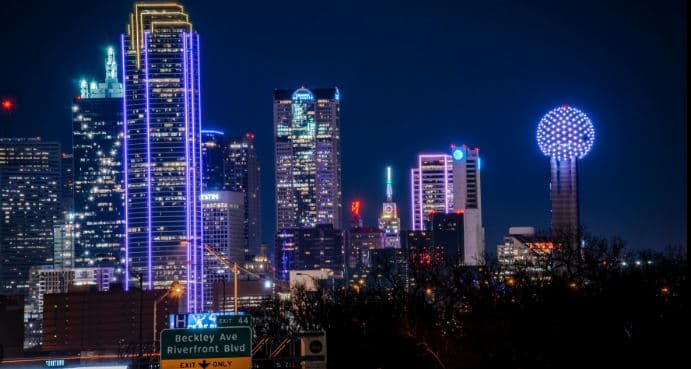
DFW is now a genuine global corporate headquarters city. The 2020s relocation wave brought Charles Schwab, McKesson, HPE, Oracle (DFW operations), CBRE, and others. Combined with legacy anchors like AT&T, American Airlines, Toyota North America, and Lockheed Martin, the metro has a Fortune 500 presence that rivals Chicago. The finance sector — anchored by Goldman Sachs, JP Morgan, and a growing alternative investment community — has become the second-largest financial hub in the country after New York. Healthcare employs nearly 400,000 workers across hospitals, research, and health tech.
Net New Jobs (decade)
450K+
Most of any US metro
AT&T HQ Campus
$1.35B
Downtown Dallas investment
Google AI Investment
$40B
DFW data center component
Dallas Fed Job Growth
1.9%
Projected 2026
Largest Employers
AT&T, AA
+ Lockheed, Toyota, CBRE
Unemployment
3.6%
Below US average
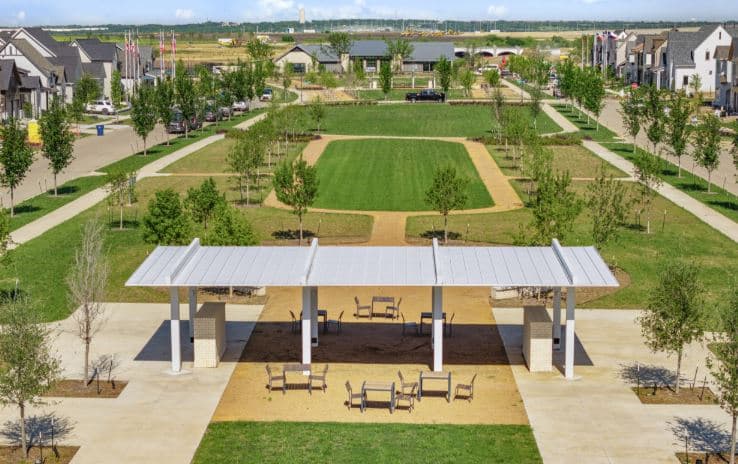
DFW's suburbs offer newer construction and strong school districts

Walkable town centers are a hallmark of DFW's best suburbs
Submarket Breakdown
DFW is a massive metro spanning 9,000 square miles. The Collin County suburbs to the north (Frisco, Plano, McKinney, Allen) are the primary family relocation destination. The Tarrant County markets (Fort Worth, Keller, Colleyville) offer more value with similar quality of life. Prosper and Celina represent the frontier — fast-growing, newer construction, longer commutes.
| Community | Character | Best For | Price Tier |
|---|---|---|---|
| Frisco | Master-planned, family hub | Corporate families, school priority | $450K–$800K |
| Plano | Established, corporate campus | Finance/tech workers | $400K–$750K |
| McKinney | Historic downtown + growing suburbs | Families, value seekers | $380K–$650K |
| Allen | Tight-knit suburb, great schools | Families | $380K–$620K |
| Colleyville | Affluent, smaller feel | High-income families, DFW airport access | $650K–$1.2M |
| Southlake | Premium suburb, top-rated schools | Affluent families | $800K–$2M+ |
| Fort Worth | Urban + sprawling west suburbs | Value buyers, urban seekers | $280K–$550K |
| Celina / Prosper | Fastest-growing, new construction | Young families, value seekers | $380K–$600K |
| Grand Prairie / Arlington | Central, accessible, value | Commuters, first-time buyers | $270K–$430K |
School Districts
DFW has some of the best suburban school districts in Texas. Carroll ISD in Southlake consistently ranks among the top 10 in the state. Frisco and Plano are regarded nationally as models for suburban public education. These ISDs are a primary factor driving relocation demand.
| District | Coverage Area | Reputation |
|---|---|---|
| Carroll ISD | Southlake, Grapevine area | Exceptional |
| Frisco ISD | Frisco, portions of Plano | Excellent |
| Plano ISD | Plano, Allen (partial) | Excellent |
| Allen ISD | Allen | Very good |
| McKinney ISD | McKinney | Very good |
| Keller ISD | Keller, Fort Worth north suburbs | Very good |
| Lewisville ISD | Flower Mound, Lewisville, Coppell | Good–Very good |
Note: DFW sits in tornado country. The metro averages 10–15 tornado events per year. Quality home construction and storm shelters are standard in newer builds; verify before purchase.

True Cost of Homeownership
The example below models a $375,000 purchase at the metro median, with 20% down ($75,000), a 6.75% 30-year mortgage, and DFW's typical 1.8–2.1% effective property tax rate. The $140,000 homestead exemption provides meaningful annual savings for primary residents.
Est. Monthly Mortgage
$1,955
$300K balance · 6.75% · 30yr
Est. Property Tax
~$500/mo
After $140K homestead exemption
Est. Homeowner's Insurance
~$140/mo
Standard coverage
Total Monthly Housing
~$2,595
Before HOA or utilities
HOA fees are common in DFW suburban communities: $50–$200/mo in most master-planned developments. Utilities average $180–$260/mo.
Honest Assessment
Strong fit if...
- ✓You relocated for a corporate position or expect to
- ✓You need DFW Airport access (one of the world's busiest)
- ✓Suburban family lifestyle is your priority
- ✓Top-rated school districts are a decision driver
- ✓You work in finance, tech, healthcare, or logistics
- ✓You value newer construction and master-planned amenities
May not be the right fit if...
- —You strongly prefer urban, walkable neighborhoods
- —Outdoor / nature access is your top lifestyle priority
- —You dislike suburban sprawl and long drives
- —You prefer smaller-city feel over metro scale
- —Tornado risk is a significant personal concern
- —You need a coastal or Hill Country lifestyle
Sources: TRERC · Redfin · Zillow · Dallas Fed · U.S. Census · Texas.gov · Updated Q2 2026
Find My Texas →